
URGENT: No Sign-Off On Destruction Project at Tomales Bay
This alert is no longer active, but here for reference. Animals still need your help.
The public has one last opportunity to tell the California Coastal Commission, “No, do not assault the dense and damp coastal forest of Tomales Bay State Park with chainsaws, chippers, masticating machines, and herbicides.” These industrial so-called “treatments” will destroy over 1000 acres of this healthy, fog-collecting, fire-resistant forest, scare away thousands of animals, and pointlessly obliterate this forest habitat.
California State Parks (Cal Parks) officials are moving full steams-shovel ahead with their 10-year-long heavy machinery deforestation project. Now Cal Parks needs the Coastal Commission to sign off on its Notice of Impending Development (NOID), which is in reality an impending deforestation. “Development” is the vague bureaucratic term that hides the destructive truth of chainsaws, chippers, masticating machines, and hundreds of gallons of toxic herbicides killing hundreds of trees and thousands of shrubs in a healthy, wild, unmanaged forest.

No Proper Environmental Review
No site-specific Environmental Impact Report (EIR) was done for this project, which is required under the California Environmental Quality Act (CEQA). Instead, Cal Parks is attempting to bypass CEQA and a proper, thorough, environmental review. It is counting on bypassing an unsuspecting public, too.
Instead, Cal Parks is relying on a general, statewide California Vegetation Treatment Plan (CalVTP), which makes no differentiation, for example, between this northern California coastal forest, and chaparral habitats hundreds of miles away in Southern California. Wild animal habitats throughout the Golden State, and the West, are now under siege by state agencies doing the bidding of the logging industry. But the Tomales Bay deforestation project must have the California Coastal Commission's approval, for compliance with the California Coastal Act.
This Deforestation Project Is One of Many
Even if you live far from this lush coastal forest in the San Francisco Bay Area, this monstrous, industrial “thinning” project is like hundreds of other, similar, so-called “management” projects. All are similar projects that destroy trees and understory plants where countless wild animals cling to survival in the face of human development and, increasingly, “wildlife management” — which is an oxymoron. Literally, hundreds of thousands of acres of public forests in the western U.S. are under assault.
These state agencies are in effect partnering with the logging industry and its cousin, the so-called “biomass” (wood pellets) industry. Both demonize forests, characterizing them as wildfire hazards that must be cut down under the guise of “thinning.”
Frightening The Public To Advance Forest “Management”
More euphemisms are designed to terrify the public and hook the media with stories about “catastrophic” wildfires, and calling forests “fuel loads” then proposing chainsaws and herbicides as the only medicine, or “treatments” which denude forests, poison the soil, and contaminate waterways. Poisoned too are countless insects, organisms, birds, and other animals, while natural, self-regenerating forest ecosystems are degraded. None of these animals are considered in the cursory CalVTP. It's as if they don't exist. If this decade-long assault is approved, many of them won't.
To fool the public, chainsaws, masticators, and herbicides in wild forests are called “treatments” as part of “management,” and “thinning” projects.
When We Need More Trees, More Trees Are Under Assault
In our climate emergency, instead of protecting forests, agencies are cutting more forests down. In effect, they're killing forests in order to “save” them from natural fires, which restore forests, as they have done for millions of years. (Despite what you've read in mainstream media, the last decade has seen a reduction in the amount of wildfire historically.)
But there is money to be made by scaring the public and cutting down and chemically “treating” forests, rather than actually protecting communities from wildfires with simple home preparations, like removing dried brush from around houses, creating defensible space next to houses, and keeping roofs and gutters free of leaves and debris. Effective fire preparedness is done from the house-out, no more than 100 feet, not from the forest-in, when forests are over 100 feet from the house.
Increasing, Not Decreasing, Wildfire Danger
In addition to harming forest health, the Tomales Bay State Park deforestation project will do nothing to reduce wildfire danger to nearby communities as its proponents claim. It could, in fact, increase wildfire danger by denuding (“thinning”) the forest, which will make it sunnier, hotter, drier, and windier, all factors that increase the chance of wildfire ignition, and a fire burning more rapidly once ignited.

Letter to Decision Maker(s) for reference:
Subject: Do NOT approve deforestation project in Tomales Bay State Park
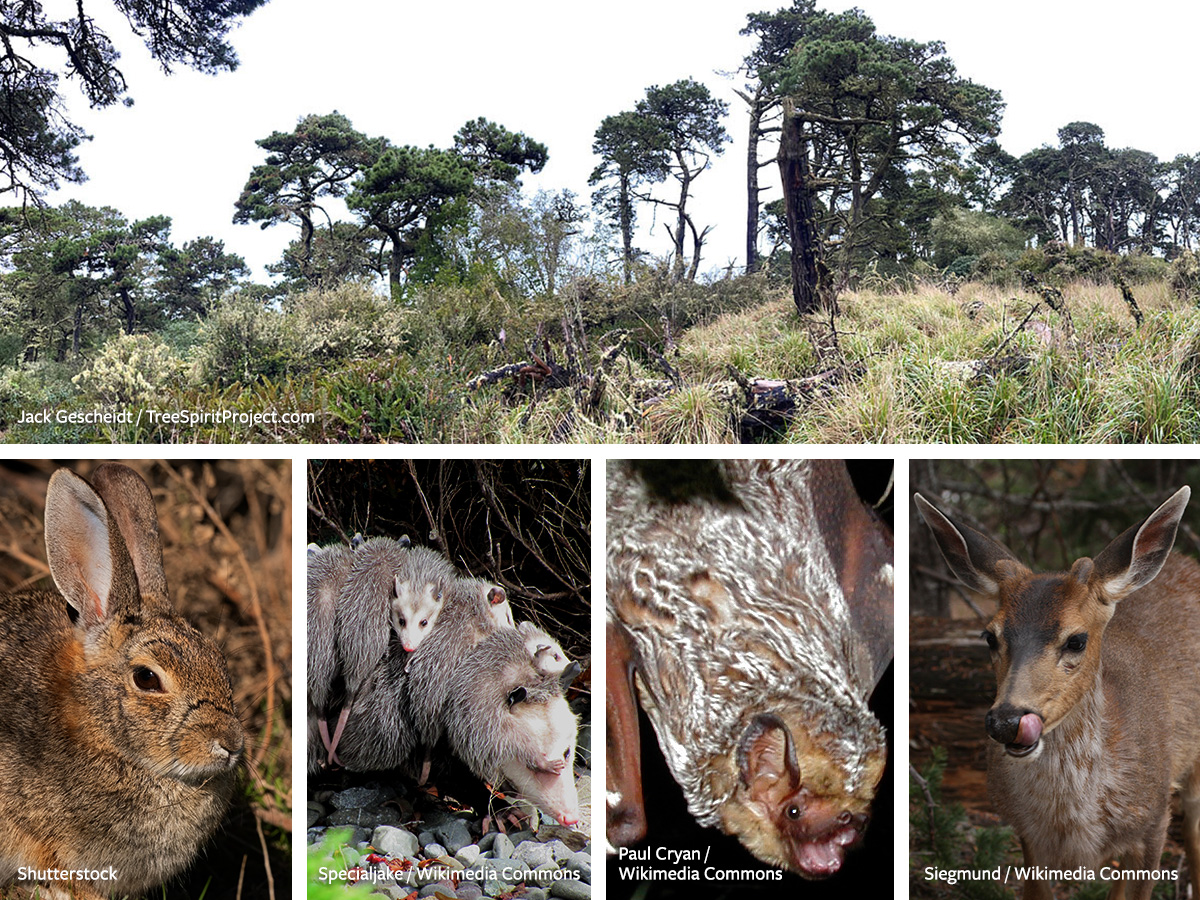
The forest at Tomales Bay State Park — including its Bishop pine tree stands — is healthy. Due to its proximity to both Tomales Bay and the Pacific Ocean, the forest captures unusually large amounts of coastal fog and thus is wetter and lusher — and thus more wildfire resilient — than most inland California forests.
This forest is also relatively wild and unmanaged, and thus a rare haven for thousands of birds and mammals of all kinds who live here quietly, in safety, away from human activity. This safe haven’s peace and quiet will be shattered by California State Park’s industrial “management” project. The high-decibel noise of chainsaws, chippers, and masticating machines will drive animals away, and then destroy their homes in trees and thousands of shrubs.
The project will also ruin the park’s human visitor experience — with a decade of ongoing heavy machine noise.
This project avoided a site-specific Environmental Impact Review, required under CEQA. Instead the extremely broad, programmatic “CalVTP” is offered up as a replacement for a thorough environmental review, and it is woefully inadequate.
The project’s meager wildlife “surveys” do absolutely nothing to prevent thousands of animals of all sizes and kinds, from mice and wood rats to bats, raccoons, and rabbits, from fleeing the forest. Their habitat, their homes, will be destroyed by masticating machines and mulched to wood chips. Many forest animals will die as a result of this project — in a supposedly protected state park forest.
This project’s so-called forest “thinning” is just a euphemism for logging, to hide its destructiveness. Its twin claims of benefit — to improve forest health or increase wildfire resilience — are not by respectively ecological science, or by wildfire science. No peer-reviewed studies support the project’s broad and vague claims.
Numerous scientific critiques of the Cal Park’s project exist, but are being ignored, including this one by the Western Watersheds Project’s California director, Laura Cunningham, a biologist:
https://idausa.org/WesternWatersheds
Cutting down untold hundreds of live trees and hundreds more dead-standing trees (“snags”) will only increase the risk of wildfire ignition, not decrease it as the project claims. “Thinning” a forest leaves it more open, sunnier, hotter, and thus drier and windier. This increases the likelihood of a wildfire ignition and thus is a danger to nearby communities.
Houses and communities are best protected from wildfire ignitions with proven home “hardening” treatments and by creating defensible space no more than 100 feet from houses. Cal Parks’ “treatments” ignore wildfire science, contradict ecological science, and defy common sense.
In addition, applying countless gallons of herbicides in a wild forest, as this project proposes, is an ecologically destructive chemical poison treatment. These formulations are toxic and banned in many municipalities.
The forest’s moist, spongy soil will be desiccated and contaminated by the hundreds of gallons of herbicides. Surface water, too, will be contaminated as it drains into Tomales Bay — harming and/or killing thousands more microorganisms along the way.
The project is a massive killing spree that directly contradicts Cal Parks’ mandate to steward, preserve, and protect wild forests. Instead, the project will denude and destroy the forest, under the false flags of “fuel load reduction” and “wildfire resilience,” and the most absurd claim of all, “forest healthy initiative.”
This project will kill a forest in order to “help” it. It will increase wildfire danger while purporting to reduce it.
I respectfully implore the Commission to deny the Notice of Impending Development (NOID) consistency determination with the Coastal Act for this project.
Sincerely,
Signed
This alert is no longer active, but here for reference. Animals still need your help.


